
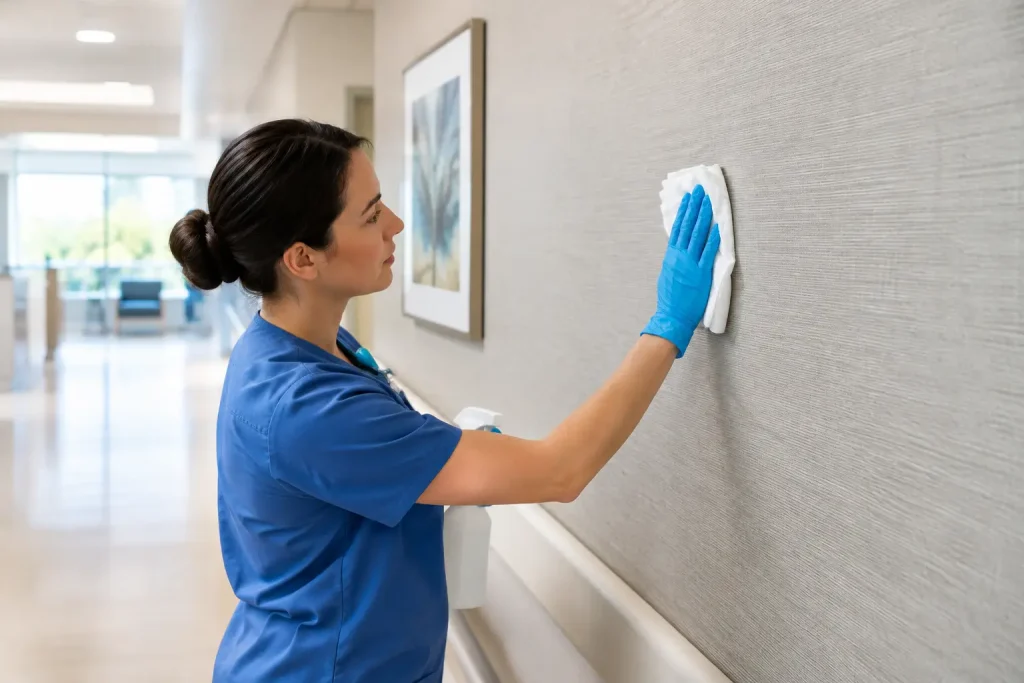
A hospital wallcovering protection example is rarely just about making a printed feature wall look good on installation day. In a busy corridor, waiting area or clinical department, the graphic will be touched, wiped, knocked by equipment and exposed to regular cleaning. If its protective finish is not specified for those conditions, colour, print detail and hygienic appearance can deteriorate long before the wallcovering reaches the end of its intended service life.
Consider a digitally printed wallcovering installed along a paediatric outpatient corridor. The design uses calm colours, local illustrations and wayfinding cues to reduce anxiety and help families find the right department. Within weeks, the lower wall is taking contact from buggies, wheelchairs, bags and mobile equipment. Staff clean the surface frequently. Children touch it. An unprotected print can soon show grey scuff marks, local staining and a dulled appearance around doorways and corners.
The practical answer is to treat the wallcovering as a working surface, not simply a decorative print. A compatible liquid protective coating can preserve the visual finish while resisting abrasion, moisture, dirt and the cleaning products used on site.
The hospital wallcovering protection example in practice
For this corridor installation, the print producer starts with a suitable digitally printable wallcovering substrate and ink set. That choice matters, but it is only part of the specification. The printed face must then be protected without a heavy plastic film that can alter the texture, leave vulnerable seams, complicate application or prove unsuitable around complex details.
A water-based liquid laminate is applied across the printed surface in a controlled, even coat. Depending on the look required, the coating can retain a low-sheen decorative appearance, give a satin finish or add gloss where image depth is the priority. Once cured, it forms a clear protective layer over the image rather than covering it with an adhesive film.
The result is a surface designed for real use: routine wiping, incidental moisture, finger marks and repeated low-level abrasion. It does not make a wall indestructible, nor does it remove the need for proper cleaning procedures. It does, however, give the print a far better chance of staying presentable between planned refurbishments.
Why the lower half of the wall fails first
In hospitals, damage patterns are predictable. The first 1.2 metres of a corridor wall take most of the impact from beds, trolleys, wheelchairs and cleaning equipment. Around lift lobbies, reception points and clinic entrances, people pause and lean against the wall. Near handrails, wallcoverings receive repeated contact and can be difficult to clean without affecting unprotected ink.
These are the areas where a coating specification proves its value. A protective coating reduces the risk of everyday contact becoming permanent visual damage. It can also make the surface easier to clean, because dirt sits on the protective layer rather than being worked into the printed face.
In high-impact zones, wall protection should still be considered alongside the print. Crash rails, corner guards and suitable wall protection panels handle severe mechanical impact that no decorative coating is designed to absorb. Liquid coating protects the graphic; physical protection handles repeated collisions.
Protection must suit the cleaning regime
Healthcare estates teams follow cleaning protocols that vary by area, risk level and operational need. A wallcovering in a public waiting room may face regular detergent cleaning, while one near treatment spaces may be cleaned more often and with more demanding products. Specifying a finish without checking the actual cleaning regime is one of the most common, and most avoidable, mistakes.
Ask the facilities or infection prevention team which products are used, how often cleaning takes place and whether a dwell time is required. The print producer can then assess coating compatibility against the chemical exposure. Test panels are valuable here: they show whether the specified substrate, ink, coating and cleaner work together before several hundred square metres of wallcovering are installed.
Antimicrobial coatings can be relevant where an appropriate, validated system is required, but they should not be treated as a replacement for cleaning, infection-control procedures or careful material selection. Claims must be tied to the exact coating system, test method and application conditions. Clear technical language protects everyone involved in the project.
Wipe-clean is not the same as chemical-resistant
A wallcovering can feel smooth and wipe-clean yet still be vulnerable to repeated exposure to certain chemicals. Over time, an incompatible cleaner may soften a finish, make the gloss uneven, create haze or affect adhesion at the edges. Equally, a coating that performs well on one ink system may need a different application method or cure period on another.
That is why a sample should be printed, coated and fully cured before chemical testing begins. It is a small step that can prevent an expensive replacement programme after installation.
Choosing liquid protection over film lamination
Film lamination remains a familiar finishing route, but it is not automatically the best choice for hospital wallcoverings. Films suit certain graphics, yet wide decorative wallpaper panels make different demands. Texture, joins, mural alignment, dimensional stability and a natural wallcovering appearance all need to be considered.
A liquid coating is particularly useful where a film would make the material feel too plastic, interfere with the intended finish or be difficult to apply without visible handling marks. It can be applied with suitable coating equipment for consistent production output, or by a controlled hand-applied process for smaller specialist projects. The right method depends on volume, substrate, coating chemistry and the finish expected.
Water-based systems also offer a practical sustainability advantage where they help producers avoid extra plastic finishing films. Fewer material layers support a more considered specification while still extending print life. The environmental benefit is greatest when the coating genuinely reduces early replacement, waste and repeat installation work.
A specification process that prevents costly surprises
The best hospital wallcovering projects bring the printer, installer, designer and a facilities representative into the discussion early. The visual brief is important, but the service conditions should drive the finishing decision.
Start by identifying the location: public corridor, ward entrance, waiting room, staff area or clinical space. Then establish the likely level of contact, cleaning chemicals, moisture exposure, lighting conditions and expected refurbishment cycle. A wallcovering behind a reception desk faces different risks from one beside a busy bed route.
Next, check the full construction. The coating must be compatible with the printed ink, the wallcovering face and the installation adhesive. Application weight matters: too little coating may give insufficient protection; too much may change flexibility, drying behaviour or surface appearance. Correct drying and curing times are equally important before rolling, packing and installation.
Finally, produce a signed-off sample panel. View it under the site lighting, clean it the way the hospital will and inspect it after abrasion exposure. This gives specifiers confidence that the colour, sheen and performance are fit for purpose, not merely attractive in a studio.
Protect the message as well as the material
Hospital graphics often do more than decorate. They direct visitors, identify departments, reassure patients and contribute to a calmer environment. When a wallcovering becomes stained, scuffed or visibly worn, its message loses clarity and the space can feel less cared for.
ClearShield liquid laminate systems are designed for exactly this kind of application-led protection, helping print professionals enhance, protect and preserve digitally printed surfaces without relying solely on plastic films. The right product and process should always be confirmed against the individual wallcovering construction and site requirements.
A well-specified coating will not prevent every mark or replace good maintenance. What it can do is keep an essential visual asset looking cleaner, easier to maintain and in service for longer – often the difference between a successful healthcare interior and one that needs attention far too soon.
