
+44 1252 624411 info@liquid-lamination.co.uk Water-based and UV liquid laminates · Inkjet sprays · Coating machines
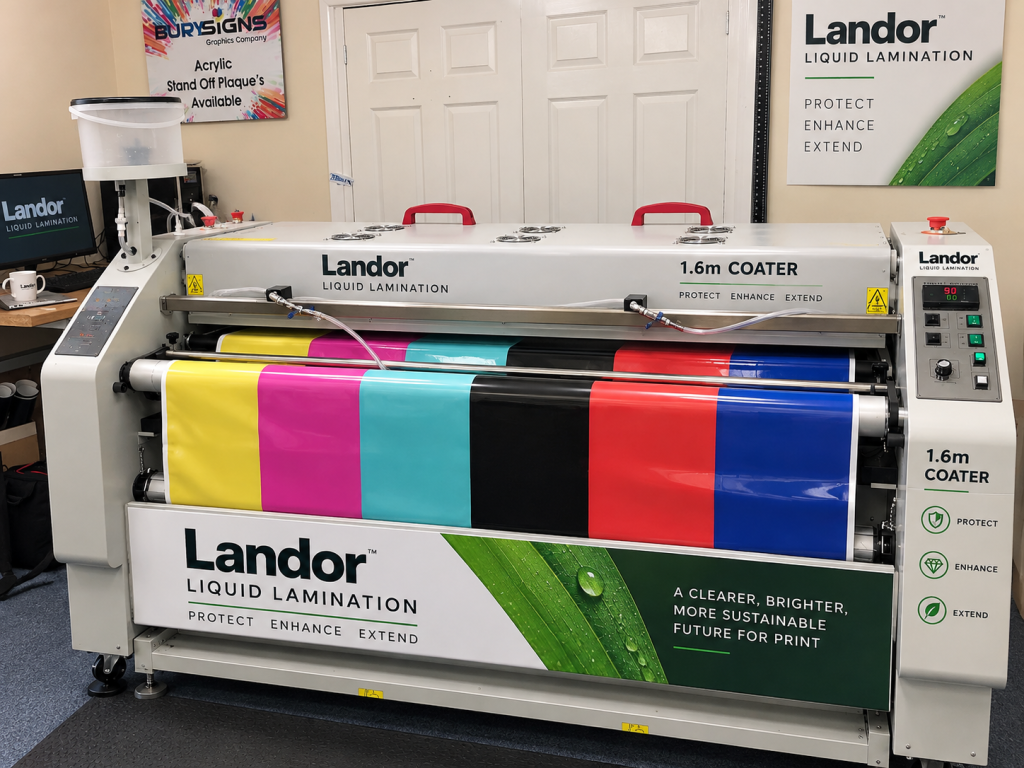
A print can look flawless when it leaves the press and still fail before the job reaches its intended lifespan. Scuffs during installation, rain on an exterior sign, cleaning chemicals in a public space and constant handling on a retail graphic all take their toll. The right inkjet coating machine turns protective finishing into a controlled production process, helping print businesses enhance, protect, preserve and extend the life of digitally printed work without relying on plastic laminate films.
For wide-format producers, signmakers, vehicle graphics specialists and wallpaper installers, the decision is not simply about buying a machine that applies liquid. It is about matching coating chemistry, application method, drying or curing capacity and production speed to the jobs that generate revenue. Get that match right and coating becomes a dependable value-added service. Get it wrong and even a good coating may deliver inconsistent appearance, poor adhesion or an unnecessary bottleneck.
An inkjet coating machine applies a measured layer of protective liquid coating across a printed surface. Depending on the system, application may be achieved with rollers, spray technology or UV-curable coating equipment. The coating then dries or cures to create a protective finish that can improve abrasion resistance, water resistance, UV stability, chemical resistance and cleanability.
Unlike adhesive film lamination, liquid coating conforms to the printed surface without the handling challenges of a separate film. This is particularly valuable where films can silver, lift at edges, struggle around contours or change the character of a textured substrate. Liquid systems can also provide a practical route for coating canvas, fine-art reproductions, wallcoverings, banners, display panels and specialist industrial graphics.
The finish matters as much as the protection. A gloss coating can deepen colour and create visual impact, while satin and matt finishes can reduce glare for wall graphics, exhibition displays and fine-art applications. The machine must apply that finish evenly, with the coating weight and surface appearance suited to the substrate and image.
Machine selection should begin at the point of use, not on the production floor. Ask what the finished print will face after it has been delivered. An indoor point-of-sale graphic may need protection from handling and routine cleaning. A vehicle livery must withstand weather, road grime, wash-down procedures and flexing. Digital wallpaper may be exposed to repeated contact, cleaning and scuffing in corridors, hospitality venues or healthcare settings.
Four questions provide a useful starting point:
These factors influence the coating choice first, then the equipment required to apply it reliably. A coating system designed for flexible graphics is not automatically the right answer for rigid board or textured canvas. Equally, the fastest coating line may be a poor commercial fit for a studio producing short runs of high-value giclée editions.
This is often the central decision. Both approaches can provide excellent protection, but they suit different workflows, materials and production priorities.
Water-based liquid coatings are widely used where a lower-impact finishing process, straightforward operation and substrate versatility are important. They can be particularly effective for digitally printed graphics, banners, canvas, wallcoverings and many flexible display applications. They offer a credible alternative where plastic laminating films are unsuitable or undesirable.
The key production consideration is drying. A machine needs sufficient drying capacity for the coating weight, substrate and throughput. If the coating is not properly dried before winding, stacking or dispatch, the print can block, mark or lose the finish quality the customer expects. Ambient conditions also matter. Temperature, humidity and airflow can affect drying times, so the real test is whether the system performs consistently on a busy production day, not only on a small sample.
UV-curable coating systems cure rapidly under UV energy, making them well suited to production environments where speed, repeatability and immediate handling are priorities. They can be especially effective for rigid sheets, commercial display graphics and applications where a hard-wearing, high-quality surface is required.
However, UV curing brings its own requirements. The substrate must be compatible with the curing process, and operators need to manage lamp output, conveyor speed, coating weight and heat sensitivity. A UV system may justify its higher investment when volumes are steady and the work demands fast turnaround. For lower volumes, varied substrates or predominantly flexible media, a water-based solution may offer more practical flexibility.
There is no universal winner. The right route depends on print volume, media range, required finish, available floor space and the failure risks the finished graphics must resist.
Working width and quoted speed are useful figures, but they do not tell the whole story. A coating machine must fit the actual jobs passing through your business. Measure the largest practical sheet, roll or panel you expect to coat, including the margin needed for safe handling. Consider whether prints arrive as individual boards, rolled media or awkward pieces that require manual feed and take-off.
Coating consistency deserves close scrutiny. The application head or roller system should lay down an even film across the whole width, avoiding streaks, puddling, dry bands and excessive edge build-up. On high-gloss work, minor variation can be visible immediately. On matt work, inconsistent coating can alter the intended appearance of solid colours and dark image areas.
Also assess the full workflow. A fast applicator has limited value if prints must wait for drying, cannot be safely stacked or need frequent rework. In many businesses, the best system is the one that reduces touchpoints and gives the operator confidence that each print will leave with the same finish as the sample approved by the customer.
A coating machine can only perform well when the print is ready for coating. Ink must be fully dry or cured according to the ink manufacturer’s guidance. Residual solvent, insufficient outgassing or uncured ink can compromise adhesion and cause surface defects. This is particularly relevant for solvent and eco-solvent output, where allowing adequate time before finishing protects both the print and the coating result.
Keep the coating area clean. Dust, fibres and airborne debris can become trapped in the surface, especially on gloss finishes. Operators should use clean handling practices, inspect prints before coating and maintain rollers, spray components and drying areas as part of routine production discipline.
Testing is not an optional extra for demanding work. Coat representative samples using the actual print mode, ink set, substrate and finish required. Check appearance, adhesion, flexibility, rub resistance and response to the cleaning products likely to be used on site. For exterior graphics, assess weathering expectations. For public-facing surfaces, evaluate the risks of graffiti, repeated touch and aggressive cleaning.
Protective finishing is easiest to sell when it is linked to a real exposure risk. A client ordering vehicle graphics does not need a vague upgrade. They need a finish that helps preserve appearance through weather, washing and daily road use. A facilities team specifying printed wallcoverings needs confidence that the surface will remain presentable through cleaning and contact. A fine-art studio needs a finish that protects an edition while respecting image detail and intended sheen.
This application-led approach also helps avoid over-specification. Not every print needs the same level of protection, and a premium coating system should be used where its performance has clear value. Offering an appropriate finish for the environment can reduce complaints, replacements and reprints while creating a stronger margin than unprotected print alone.
Landor Liquid Lamination supports this process with coating systems, equipment, demonstrations and technical guidance shaped around the end use rather than a one-size-fits-all machine sale. That practical support is particularly valuable when introducing liquid coating to an existing print workflow or moving a regular product line away from film finishing.
The best results come from standardising the process for each recurring application. Record the coating type, application settings, drying or curing conditions, substrate, print profile and finish level that have been approved. This makes repeat orders easier to produce and gives operators a clear reference when work changes hands.
Schedule maintenance with the same care as printer maintenance. Clean application components, inspect rollers and filters, confirm curing or drying performance, and deal with contamination before it becomes a visible quality issue. Coating equipment is a profit centre when it is reliable, not when it is only switched on for urgent jobs.
Choose an inkjet coating machine around the surfaces your customers rely on most. When coating, substrate and application conditions are properly matched, protective finishing stops being an afterthought and becomes a practical promise: the print will look better for longer, wherever it has to perform.
