
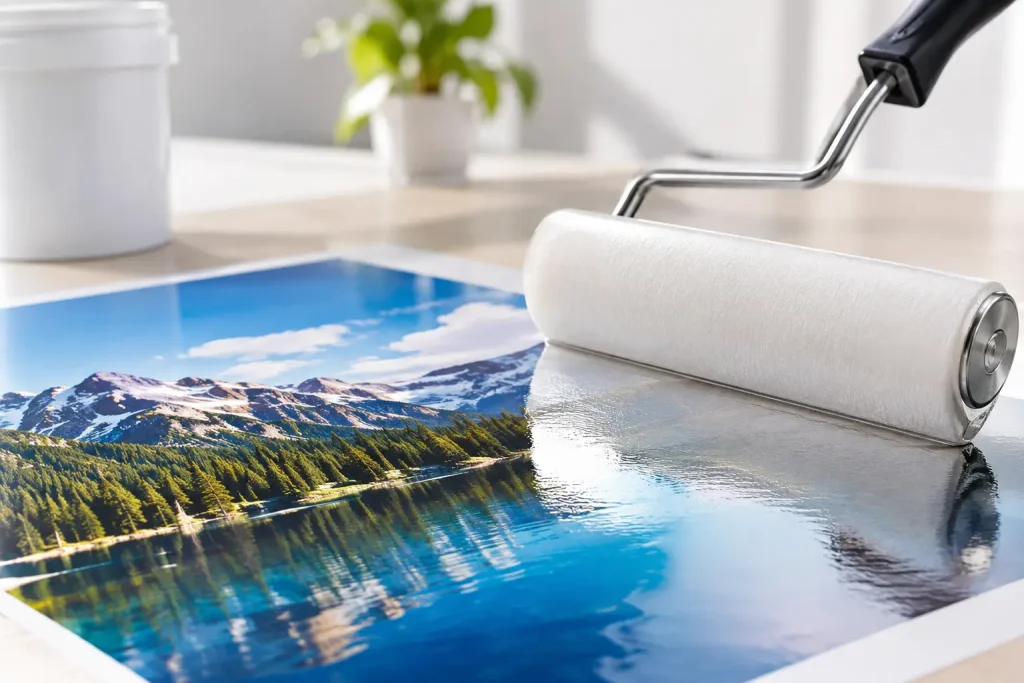
A newly installed graphic can look flawless on the production bench yet begin to fail as soon as it enters service. Vehicle livery picks up road grime and brush marks, wallcoverings meet constant hand contact, and exterior signage faces rain, pollutants and ultraviolet exposure. Water-based liquid laminate provides a practical way to enhance, protect, preserve and extend the life of these printed surfaces without applying a conventional plastic finishing film.
For print businesses, the choice is not simply between a gloss or matt finish. The right protective coating must suit the ink, substrate, expected handling, cleaning regime and working environment. A coating that performs well on a short-term indoor poster may be the wrong choice for a fleet graphic, a digitally printed wallcovering or a high-touch retail display.
What is water-based liquid laminate?
Water-based liquid laminate is a clear protective coating applied in liquid form over a printed image. As the water evaporates and the coating cures, it forms a protective surface layer designed to improve durability while retaining the visual impact of the print beneath.
It can be applied by suitable coating machinery, roller systems, spray equipment or by hand, depending on the product, the scale of work and the required finish. Rather than covering the print with an adhesive-backed film, the coating follows the surface of the printed material. This makes it particularly valuable where films are impractical, where edges are vulnerable, or where a flexible, low-profile protective finish is preferred.
The coating can be selected to give a gloss, satin or matt appearance, along with application-specific resistance to abrasion, dirt, moisture, ultraviolet light and cleaning chemicals. Water-based systems also offer a more environmentally considered alternative to many solvent-heavy finishing processes and can reduce reliance on single-use plastic laminate films.
Why printed graphics need more than a good ink set
Modern digital inks can deliver excellent colour density and sharp detail, but print quality alone does not determine service life. A graphic is usually damaged at its surface first. Repeated wiping can dull a print, handling can create scuffs, and grit carried on clothing, bags or cleaning cloths can abrade the image. Outdoors, UV exposure and airborne pollution steadily affect appearance.
This is why protection should be specified at the start of the job, not added as an afterthought when a client asks why a graphic has marked prematurely. A suitable liquid coating creates a sacrificial protective layer over the ink, taking the day-to-day wear that would otherwise affect the printed image itself.
In busy commercial environments, that difference has a direct cost implication. A protected wall graphic, display panel or vehicle image can stay presentable for longer, avoiding early replacement, repeat installation and disruption on site. The most sustainable print is often the one that does not need to be remade after a short period of use.
Where water-based coatings are most effective
Water-based protection is particularly well suited to digitally printed work that needs visual quality and practical durability without the stiffness, edge lift or application limitations of film lamination. It is often selected for interior graphics, point-of-sale displays, exhibition panels, fine-art and canvas reproductions, wallpaper, signage and selected vehicle and fleet applications.
Digitally printed wallcoverings are a good example. A wallpaper installation may need to withstand occasional cleaning, everyday marks and repeated contact in corridors, receptions, hospitality spaces or retail areas. A compatible clear coating helps preserve colour and makes the finished surface easier to maintain, without adding a separate plastic film across a large wall.
Fine-art reproduction studios also need control over the finish. The wrong protective layer can make a giclée print look overly glossy, flatten its tonal range or alter the intended texture of canvas and art paper. A correctly chosen water-based coating can protect the image while supporting the desired matt, satin or gloss presentation.
For exterior graphics and vehicle livery, the assessment needs to be more demanding. Water, road film, UV and washing routines all matter. A water-based system may be highly appropriate, but only where the coating has been specified for the print process, substrate and level of exposure. High-wear applications may require a different coating chemistry, or a UV-curable solution for faster processing and particular performance requirements.
Finish is not just an aesthetic decision
Gloss coatings deepen colour, strengthen contrast and give images a vivid, polished look. They work well where a high-impact finish is part of the brief, but can show reflections under bright lighting. Matt coatings reduce glare and are often preferred for wallcoverings, display graphics and fine-art work, although a matt surface may need a carefully selected formulation where frequent cleaning is expected. Satin sits between the two, offering a refined surface with moderate reflectivity.
Agree the finish with the client using a coated sample on the actual printed substrate wherever possible. This is especially important for textured papers, canvas, soft signage materials and dark, solid print areas, where changes in surface appearance are more visible.
A coating should enhance the print rather than disguise it, and good application technique is central to this. Uneven coverage, over-application, contamination and insufficient drying can compromise the final result, whatever coating is used.
Application checks that prevent expensive reprints
Before coating production work, confirm that the print is fully dry and that the ink and media are compatible with the selected system. Residual solvent, uncured ink or a poorly matched substrate can affect adhesion and finish. Testing is not a delay in production; it is the fastest way to stop a failed job reaching installation.
Keep the work area clean. Dust, fibres and silicone contamination can become permanently visible once coated, particularly under gloss finishes. Control coating quantity and application speed to obtain an even film, then allow the material to dry and cure under the conditions specified for that coating. Dry to the touch is not always the same as fully cured and ready for packing, cutting or installation.
For volume work, machinery can improve consistency and throughput. For smaller studios, sample runs, bespoke panels and occasional jobs, a suitable starter kit or manual application may be more commercially sensible. The best method depends on production volume, media width, finish expectations and the team’s confidence with process control.
Water-based liquid laminate versus plastic film
Conventional laminate films remain useful in many graphics applications, particularly where a film-based workflow is already established. However, they have limitations. Films add material thickness, may have vulnerable edges, can be difficult to apply on certain textures and shapes, and rely on adhesive performance over the life of the graphic.
A liquid alternative removes several of these constraints. It can coat edge to edge, conform to the character of the printed surface and protect materials that are unsuitable for film. It can also reduce plastic use and the waste associated with liner-based adhesive films.
There are trade-offs. Liquid coating requires controlled application, drying time and proper product selection, and it is not a universal replacement for every film laminate. Jobs exposed to exceptional mechanical abuse, complex forming, immediate finishing deadlines or specific regulatory requirements should be assessed individually. The commercial benefit comes from selecting the right protection system, rather than forcing one process onto every substrate.
Specify protection around the real environment
Ask where the graphic will live, who will touch it and how it will be cleaned. A reception wall, a hospital corridor, a school display, a retail fixture and a lorry curtain may all be printed on similar equipment, but they face very different risks. Some locations need enhanced cleanability. Others require anti-graffiti or anti-microbial performance, stronger chemical resistance or improved flexibility through repeated movement.
This application-led approach is where specialist technical guidance becomes valuable. Landor Liquid Lamination helps print professionals match protective coatings to the conditions a graphic will actually face, rather than relying on a generic finish selected on appearance alone.
Protective coating should be built into the production specification while the print is still being planned. When the substrate, ink, finish and exposure conditions are considered together, water-based liquid laminate becomes more than a final pass through the finishing area. It becomes a practical way to deliver graphics that stay cleaner, look sharper and earn their place for longer.
