
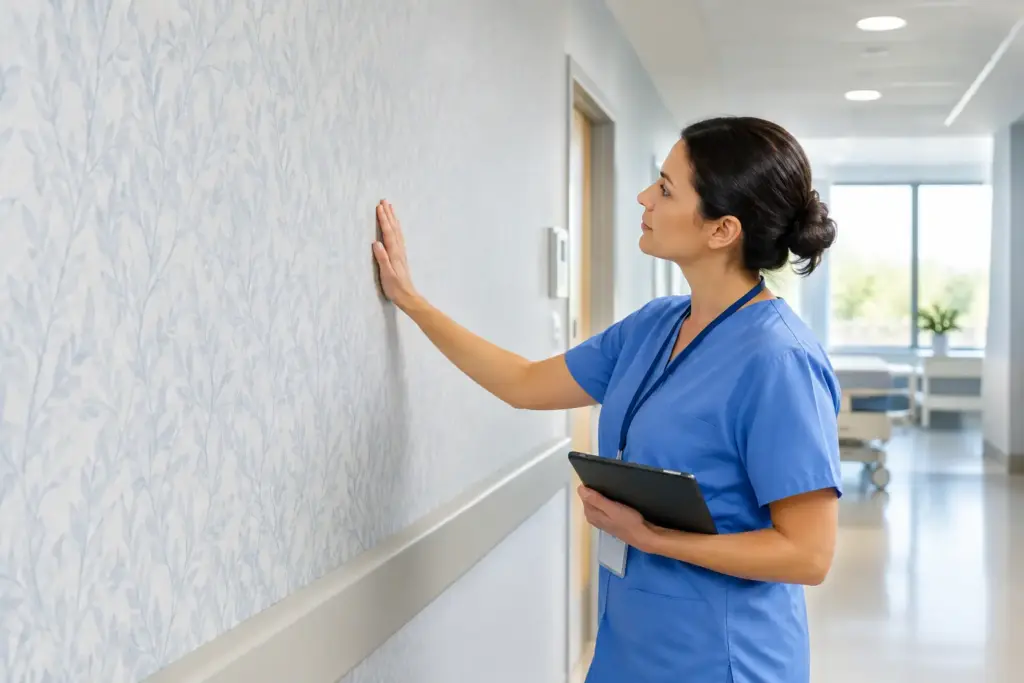
A pristine hospital wallcovering can quickly lose its authority when it starts to scuff at trolley height, stain around handrails or show dull patches after repeated cleaning. Strong hospital wallcovering coating results are not simply about adding a protective layer. They depend on matching the coating system to the printed media, the installation method, the cleaning regime and the real level of contact each area will receive.
For print producers, installers and facilities teams, the objective is clear: preserve the original image, support practical hygiene routines and extend the service life of a graphic without relying on an additional plastic finishing film. The detail lies in specifying and applying the coating correctly.
What Good Hospital Wallcovering Coating Results Look Like
The best result is often one that is barely noticed. Colour remains consistent, photographic detail stays sharp and the surface retains its chosen matt, satin or gloss appearance. Yet beneath that finish, the print has greater resistance to abrasion, moisture, soil, repeated handling and approved cleaning products.
In a hospital, wall graphics are not decorative afterthoughts. They help with wayfinding, paediatric reassurance, privacy, wellbeing and brand communication. A woodland scene in a treatment corridor or a clear directional graphic near outpatient reception has to remain legible after months of cleaning and constant passing traffic. When protection fails, the visual asset starts to look neglected long before the underlying wallcovering should need replacement.
A properly selected liquid coating can help avoid common failures such as rubbed ink, black marks, surface staining, cleaning-related dulling and premature colour change. It can also make routine wipe-down easier by providing a more protected, cleanable printed surface. However, performance is never created by the coating alone. Ink cure, print quality, substrate compatibility and application discipline all affect the outcome.
Why Healthcare Wallcoverings Fail Earlier Than Expected
Hospital environments impose several stresses at once. Corridors, waiting rooms, wards and entrances are exposed to beds, wheelchairs, trolleys, bags, shoes and regular human contact. High-touch areas around doors, seating and clinical work zones receive a concentrated level of wear that a standard commercial interior may never experience.
Cleaning adds another variable. A wallcovering may be wiped frequently with detergents or disinfectant products, particularly in areas with strict local hygiene procedures. Some chemicals can gradually alter the sheen of an unprotected print, leave visible streaks or weaken a surface that was designed only for light domestic cleaning. Steam, humidity and splashes can also test the bond between ink, coating and media.
Then there is appearance. Hospital schemes frequently use pale colours, detailed imagery and large areas of solid tone. Scuffs and scratches are more obvious on these designs than on a dark, heavily textured graphic. A protective finish therefore needs to preserve colour and visual depth, not merely offer a hard surface.
The trade-off between finish and durability
A high-gloss finish may increase perceived colour depth, but it can also highlight reflections, fingerprints and minor surface irregularities under strong clinical lighting. A matt finish can reduce glare and create a softer architectural appearance, yet it must still tolerate the anticipated cleaning process. Satin often offers a useful middle ground, though the right decision depends on location, lighting and design intent.
The coating should support the specification rather than override it. A paediatric feature wall, for example, may prioritise low glare and tactile visual comfort. A busy entrance graphic may need a finish selected primarily for cleanability and resistance to scuffing. One system does not automatically suit every hospital zone.
Specify the Coating Around the Actual Environment
The most reliable approach begins before production. Establish where the wallcovering will be installed, what it is printed on, which ink technology is used and how the site intends to clean it. Asking these questions early prevents a familiar problem: a visually impressive print is produced, installed and then exposed to a maintenance regime it was never designed to withstand.
For digitally printed wallcoverings, the coating must adhere consistently without affecting the design or causing unwanted texture. It should be compatible with the ink and media, including vinyl, non-woven and other specialist wallcovering substrates. The print must also be fully cured before coating, because residual solvents, uncured inks or contamination can compromise adhesion and appearance.
Where antimicrobial performance is requested, the requirement needs careful definition. An antimicrobial coating may form part of a broader material and hygiene strategy, but it does not replace established infection prevention procedures, routine cleaning or clinical controls. Facilities teams should ask for relevant technical evidence and ensure any performance claims align with the intended use, local policy and specification.
Test before committing to volume
A small coated sample is one of the most valuable controls in the whole project. It allows the printer, installer and client to assess colour, sheen, adhesion and cleanability before the full wallcovering run is finished. Where possible, test the sample with the cleaning products and methods likely to be used on site.
This is particularly important for digitally printed designs with deep blacks, heavy ink coverage, metallic effects, soft-touch surfaces or demanding colour matches. A coating can enhance the appearance of one print combination while producing a less desirable effect on another. Samples turn assumptions into evidence.
Application Quality Determines the Final Result
Liquid lamination offers an important advantage over adhesive films on many wallcovering projects: it can protect the printed surface without adding a separate plastic film layer that may be unsuitable for the media, contours or installed environment. But it must be applied evenly and at the correct coating weight.
Insufficient coverage can leave the wallcovering vulnerable at the very points where protection is needed. Excessive coating can affect texture, increase drying time or alter the intended look of a textured substrate. Streaks, roller marks, missed edges and contamination are equally avoidable when the process is controlled.
For volume print operations, purpose-selected coating machinery can provide repeatable application across long runs. For smaller studios, prototypes and specialist installations, a practical starter system may be more appropriate. In both cases, the same fundamentals apply: a clean work area, stable print handling, correct drying or curing conditions and operator attention to edges and overlap zones.
The junctions in the finished installation deserve particular care. Wallcovering seams, trimmed edges, corners and areas adjacent to door frames experience more stress than the middle of a panel. Coating helps protect the printed face, but it cannot correct poor wall preparation, weak adhesive selection or inadequate seam treatment. Installation quality remains part of the protection system.
Measuring Hospital Wallcovering Coating Results
Results should be judged against operational needs, not just how the sample looks on the day it is made. A useful evaluation considers whether the coating retains the required finish after cleaning, resists visible abrasion, supports print adhesion and keeps graphics readable in the installed lighting.
For a critical project, record the wallcovering media, printer, ink set, coating product, application method, dry or cure conditions and cleaner used during testing. This creates a repeatable specification for future phases, replacement panels or roll-outs across multiple sites. It also gives procurement and facilities teams a clearer basis for comparing alternatives.
The commercial value is straightforward. A wall graphic that continues to look clean and professional reduces the pressure for premature replacement, disruption and reinstallation. It also protects the investment already made in artwork, print production and fitting. Lower material waste and a longer replacement cycle support more responsible project delivery.
Landor Liquid Lamination supports this application-led approach with protective liquid coating systems designed to enhance, protect, preserve and extend digitally printed surfaces. Technical guidance is especially valuable where a wallcovering must balance visual impact with demanding cleaning and contact conditions.
Build Protection into the Brief, Not the Repair Plan
The strongest hospital wallcovering projects treat coating as a specified performance layer from the outset, not as a last-minute response to expected damage. Involve the print producer, coating specialist, installer and facilities representative early enough to test the complete system. When the finish, substrate, print and maintenance routine work together, the wallcovering can continue doing its job long after the opening photographs have been taken.
