
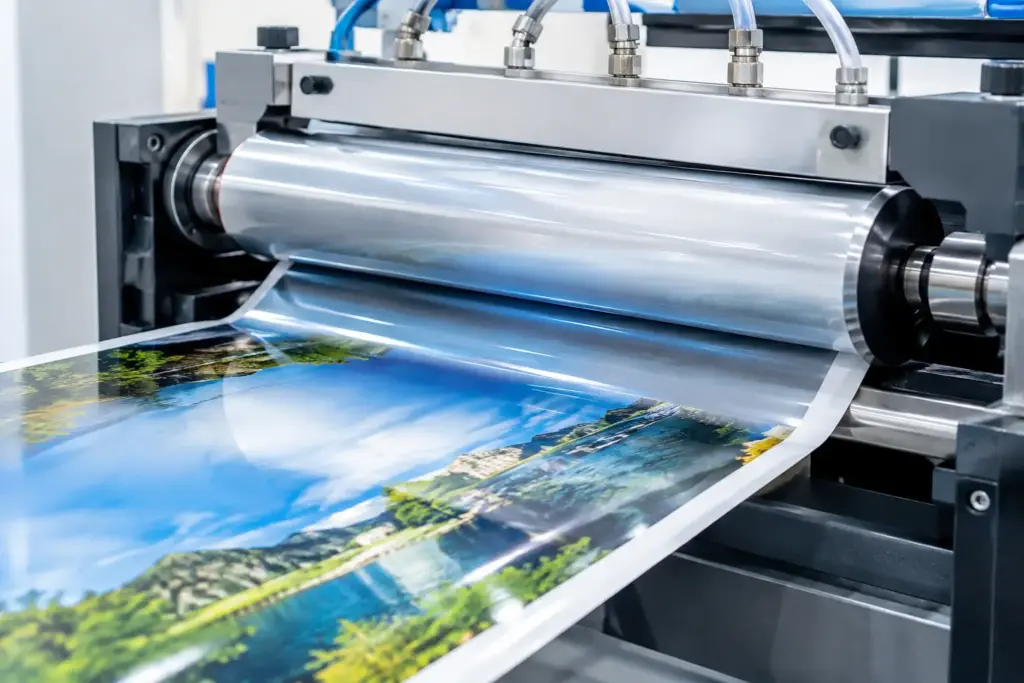
A premium print can leave the press looking excellent, then lose value the moment it is installed, handled, cleaned or transported. Coating machinery gives print businesses a controlled way to apply protective liquid coatings that preserve colour, surface finish and perceived quality without relying on an additional plastic laminate film.
For signage, vehicle graphics, digital wallpaper, retail displays, fine-art reproductions and industrial graphics, the right system is not simply a faster way to coat. It is part of a finishing process designed around the real conditions the print will face: abrasion, UV exposure, water, cleaning chemicals, repeated touch, dirt and pollution. Selecting the right equipment starts with the application, not the machine specification alone.
What coating machinery needs to achieve
Liquid coating equipment must apply a consistent film weight across the full printed surface, while protecting the image rather than compromising it. An uneven layer can leave visible roller marks, variable gloss, weak protection at the edges or an inconsistent tactile finish. Too much coating can affect appearance, drying time and cost per square metre. Too little may not provide the durability the job requires.
The best process balances four factors: substrate, ink technology, required finish and expected service life. A short-term indoor poster has very different needs from a bus graphic, a hospital wallcovering or a retail panel cleaned several times each day.
For this reason, production teams should consider coating machinery as part of a complete system. The coating chemistry, application method, drying or curing method and operator workflow must work together. This is where specialist technical guidance can prevent expensive trial and error.
Choose equipment around the job, not the brochure
There is no single machine that suits every print room. The correct choice depends on format, throughput, media range and the coating performance required after installation.
Roller coating systems for wide-format graphics
Roller-based liquid laminators are a practical option for many signmakers and print producers. They can apply water-based protective coatings evenly to wide-format prints, self-adhesive vinyl, banners, canvas and wallpaper, provided the selected coating is compatible with the substrate and ink set.
These systems are particularly valuable where conventional film lamination is difficult, undesirable or uneconomic. Textured surfaces, irregular materials and applications where a very natural printed appearance matters can all benefit from a liquid-applied finish. The coating conforms to the surface rather than adding a separate adhesive film layer.
Roller coating requires careful set-up. Nip pressure, application roller condition, coating viscosity and feed speed all influence the result. Operators should be able to clean the system efficiently between jobs, especially when changing coating type or finish. A machine that is simple to maintain is often more commercially useful than one with specifications that exceed the actual production requirement.
Spray coating systems for detailed or specialist work
Spray application can be the better route for substrates that do not travel easily through a roller machine, for shaped items or for work where a particular sprayed aesthetic is required. It can also provide a practical solution for selected fine-art, display and specialist graphic applications.
The trade-off is process control. Spray coating needs suitable extraction, a clean working environment and disciplined operator technique to achieve an even finish. Overspray, contamination and inconsistent application distance can affect appearance and waste material. For lower volumes and specialist work, those considerations may be entirely acceptable. For high-volume production, a roller-fed process can be easier to standardise.
UV-curable systems for immediate processing
UV-curable coating systems cure rapidly under UV energy, allowing coated work to move into the next production stage with minimal delay. This can be highly effective for rigid boards, display graphics and demanding industrial applications where fast turnaround, surface resilience and controlled production are priorities.
However, UV curing is not automatically the right answer for every substrate. The capital investment, energy requirements, heat sensitivity of media and the coating’s flexibility after cure all need assessing. Flexible vehicle graphics and materials that must be folded, stretched or formed require a coating system designed to move with the substrate.
Water-based coatings may offer a more appropriate route where low-odour processing, flexible finish and a sustainability-led approach are important. The drying stage must be planned properly, whether through ambient drying, forced air or assisted heat. The right answer depends on how quickly work must leave the production floor and what it must withstand afterwards.
The finish is a performance decision
Gloss, satin and matt are often treated as visual choices, but finish also affects practicality. A gloss coating can intensify colour and create a high-impact surface for promotional graphics. A satin finish can reduce glare while retaining colour depth. Matt finishes suit many wallcoverings, fine-art prints and interiors where reflection would distract from the image.
Each finish should be tested on the actual printed material. Ink density, media texture and print mode can change the final appearance. A coating that looks excellent on smooth vinyl may behave differently on uncoated paper, textured canvas or digitally printed wallpaper.
Protection requirements must sit alongside appearance. Exterior signage may need UV resistance and weather protection. Public-facing graphics may need resistance to scuffs, cleaning chemicals and repeated handling. In healthcare, education and shared public spaces, an anti-microbial coating strategy may be appropriate where surface hygiene is part of the wider specification. Where vandalism is a credible risk, anti-graffiti performance can reduce the cost and disruption of replacing printed assets.
Build a reliable coating workflow
Good machinery cannot compensate for poor preparation. Prints should be fully dry and properly outgassed before coating, particularly solvent, eco-solvent and latex outputs where retained solvents or moisture can affect adhesion and finish. Dust, silicone contamination, fingerprints and loose fibres should be removed before the print enters the coating process.
Operators also need a repeatable method for setting application thickness and recording successful job settings. Retaining a simple production record for media, ink, coating, machine speed, roller pressure and drying or cure conditions makes repeat orders far easier to control. It also gives the team a useful starting point when a new substrate presents a challenge.
Quality checks should reflect the end use. For example, a wallcovering sample may need visual inspection under installed lighting and a test for handling marks. A vehicle livery sample may need flexibility checks around curves and a realistic assessment of washing and road exposure. A display panel may need scratch resistance and chemical-cleaning tests. Test panels are inexpensive compared with a failed installation.
Consider cost beyond the machine purchase
The most affordable coating machine is not always the lowest-cost investment. Assess coating consumption, cleaning time, electricity use, operator involvement, drying space, reject rates and the likely volume of work. A system that reduces remakes and lets the business offer a higher-value protective finish can repay its cost more effectively than a cheaper unit that becomes a production bottleneck.
There is also an environmental consideration. Liquid coating can reduce dependence on single-use plastic laminate films and adhesive liners, helping print businesses cut material waste in suitable applications. That benefit is strongest when the coating process is accurately controlled, so excess application and unnecessary reprints are avoided.
Landor Liquid Lamination supports this application-led approach with machinery, water-based and UV-curable systems, demonstrations and technical advice. A demonstration using the actual media and artwork is especially valuable when the work involves unfamiliar substrates, demanding durability requirements or a high-value customer installation.
Questions to ask before you invest in coating machinery
Start with the jobs you want to win or protect more effectively. What width and volume will the machine need to handle? Which substrates are routine, and which are likely to increase? Does the output require immediate curing, or can it dry within the existing workflow? Is the finish expected to flex, fold, tolerate frequent cleaning or perform outdoors for years?
Also ask who will operate and maintain the equipment. A coating system should fit the skill level and available space of the production team. Training, accessible consumables and responsive technical support matter because consistency is what customers see on the finished print.
The most useful coating machinery is the equipment that lets you confidently say yes to demanding printed applications, while preserving the colour, finish and lifespan your customer has paid for. Test it against real jobs, specify protection with purpose, and make coating a dependable part of production rather than a last-minute add-on.
