
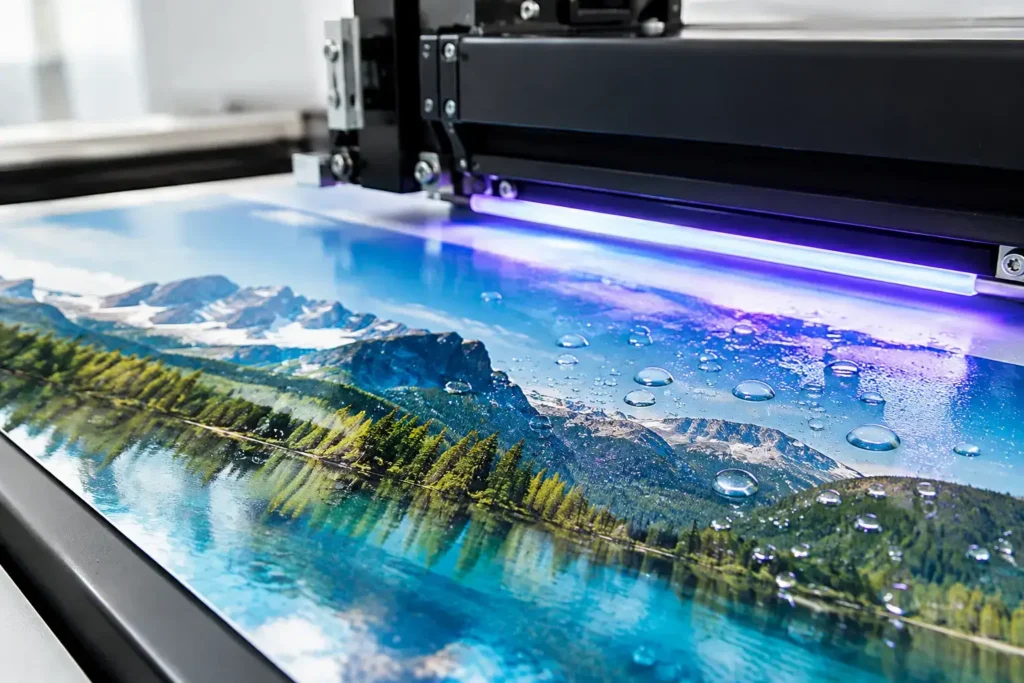
A rain-soaked vehicle graphic, an external sign repeatedly cleaned by a facilities team, and a digitally printed wallcovering in a busy public space all face the same question: is UV coating waterproof? The practical answer is that a properly specified and fully cured UV coating can create a highly water-resistant protective layer. But no coating should be treated as a universal guarantee against water ingress, immersion or failure at unsealed edges.
For print professionals, the distinction matters. A coating may protect the printed face from rainfall, splashes, wash-down and routine cleaning, yet the complete graphic can still fail if water reaches an absorbent substrate, exposed print edge, overlap, fixing point or poorly prepared surface. Protect the whole system, not only the visible print.
Is UV coating waterproof in real applications?
UV-curable liquid coatings are formulated to cure under ultraviolet light into a cross-linked film. Once correctly applied and cured, that film forms a dense, durable surface that resists moisture far better than an unprotected print. It can help prevent water spotting, ink bleed, surface staining and premature deterioration caused by regular wet weather or cleaning.
In the graphics industry, however, “waterproof” is often used too broadly. A coated graphic that survives rain on an exterior sign is not necessarily designed for prolonged immersion, standing water or continuous high-pressure washing. Likewise, a coating may be water-resistant while the media beneath it is not. Paper-based stock, untreated board, certain textiles and unsealed composite panels can absorb moisture from the reverse side or edges regardless of how well the printed face has been coated.
The more accurate specification is normally water-resistant or weather-resistant, subject to the ink, substrate, coating thickness, cure and installation method. That is not a weaker claim. It is the technically useful one, because it identifies the conditions the finished item is expected to withstand.
What a UV-curable coating protects against
A UV-curable coating does more than repel water. It creates a protective skin over the image, helping preserve the print where handling, weather and cleaning would otherwise reduce its usable life. For suitable applications, it can provide resistance to rain, damp conditions, dirt, pollutants, fingerprints, mild cleaning agents and abrasion.
This is particularly valuable on wide-format graphics where the printed surface is exposed for long periods. External signage may be hit by rain and airborne grime every day. Vehicle liveries face spray, road film and regular washing. Retail displays and public-information graphics are frequently touched, wiped and scuffed. In each case, moisture resistance must work alongside scratch resistance, chemical resistance and flexibility.
The finish also matters. Gloss coatings can enrich colour and deepen blacks, while satin and matt finishes reduce glare and can suit interiors, displays and fine-art reproduction. The right choice is not simply aesthetic. A coating system must retain the finish required by the job while delivering the protection demanded by its environment.
The coating is only one layer of the system
A water-resistant coating cannot correct weaknesses elsewhere in the build. For example, a printed self-adhesive vinyl may have an excellent coated face, but water can still find its way beneath the graphic if the edges are lifting or the vinyl has been applied over a contaminated surface. On a rigid sign panel, unsealed cut edges can allow moisture into the board core. On wallpaper, water vapour, unsuitable adhesive or poor wall preparation can lead to failure behind the print.
This is why application-led specification is essential. Consider the ink set, media, substrate, adhesive, installation environment and expected cleaning regime before selecting a coating. The strongest finish is the one that works with the entire construction.
When water resistance is enough – and when it is not
For most external printed graphics, resistance to normal rainfall and periodic cleaning is the real requirement. A UV-cured liquid coating is well suited to this type of exposure when applied at the recommended coverage and cured with appropriate UV equipment. It can extend the service life of graphics while avoiding the added plastic film and adhesive associated with conventional lamination.
There are situations where higher caution is needed. Graphics used on marine equipment, near swimming pools, in shower areas, on frequently pressure-washed vehicles, or in industrial wash-down zones may face more aggressive moisture exposure. So may graphics installed horizontally, where water can sit on the surface rather than run off. These uses require a specific assessment of coating chemistry, substrate sealing, edge protection and likely cleaning chemicals.
Prolonged immersion is a separate category. If a printed item will remain underwater or experience repeated saturation, a standard graphic coating may not be sufficient. The risk is not limited to the coating face. Water can migrate through joins, damaged areas, edges and fixings, then attack ink, adhesive or substrate from behind.
For demanding environments, specify the finish around the actual failure mode. Is the concern rain? Condensation? Salt spray? Frequent disinfectant cleaning? Jet washing? The answer determines whether a UV-curable coating, a water-based liquid laminate, an anti-graffiti system, a sealed panel construction or a different print material is the right solution.
Cure quality determines performance
A UV coating is not fully protective simply because it feels dry. UV-curable products need the correct dose of ultraviolet energy to achieve a reliable cure. Lamp output, conveyor speed, lamp distance, coating weight and the geometry of the item all influence the result.
Under-curing can leave a film with reduced chemical and water resistance, lower abrasion resistance, residual odour or poor long-term durability. Over-application can also create issues, including an uneven surface, reduced flexibility or difficulty curing through the full film thickness. On flexible graphics, the coating must bend with the media without cracking, particularly around formed vehicle panels, contours and areas subject to repeated movement.
Consistent application equipment makes a commercial difference here. Roller coaters, spray systems and purpose-designed UV curing units allow production teams to control coverage and repeat results across short runs and volume work. Before committing a job, test the complete print-and-coating combination, including any folding, forming, cutting or installation process that follows.
Prepare, coat and protect the edges
Good water resistance starts before coating. The print must be dry, clean and free from silicone, dust, oil and other contaminants that could interfere with adhesion. Ink adhesion should be verified, especially with unfamiliar media or low-energy substrates. If the ink has not bonded properly to the print surface, no topcoat can provide dependable long-term protection.
Apply the coating evenly at the recommended wet film weight, then cure it to the equipment and product specification. Allow the finished graphic to cool and stabilise before further handling, trimming, packing or installation. A rushed production process can mark a surface that has cured correctly but is still warm or vulnerable to immediate mechanical stress.
Do not overlook edges. Where moisture can enter the construction, edge sealing or an alternative fabrication method may be necessary. This is especially relevant for boards, wallpaper installations, layered graphics and vehicle applications exposed to persistent road spray. The best-looking face finish cannot compensate for a route for water behind the graphic.
Cleaning and maintenance still matter
A coated graphic should be easier to clean, but it should not be treated as indestructible. Use the cleaning method appropriate to the coating and application. Mild cleaners and soft cloths are often suitable, while abrasive pads, harsh solvents and uncontrolled high-pressure washing can shorten the life of any decorated surface.
For public spaces, transport graphics and high-touch displays, protection may need to include more than water resistance. Anti-graffiti or anti-microbial performance, where required, should be specified as part of the coating system rather than assumed from a standard clear finish. Landor Liquid Lamination supports this approach by matching liquid coating technology to the print’s exposure, handling and maintenance demands.
Choose protection around the job, not the label
The useful question is not whether UV coating is waterproof in isolation. Ask what the print must survive, how long it needs to last and where water could enter the finished construction. A correctly cured UV coating can provide excellent day-to-day moisture protection while enhancing the appearance and durability of printed graphics.
Specify for the actual environment, test the full system and protect vulnerable edges from the start. That is how a coating becomes a dependable part of a longer-lasting print, rather than a last-minute surface treatment.
