
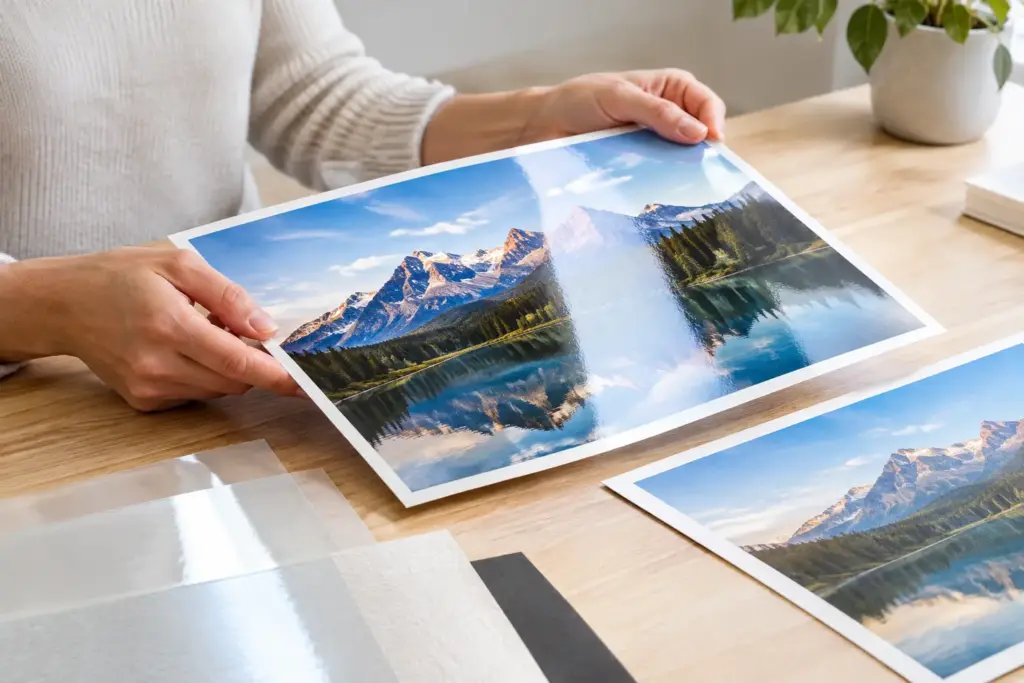
A finish can make a beautifully printed edition look considered and gallery-ready, or leave it vulnerable to scuffs, finger marks and premature fading. The best finishes for art prints are not chosen by appearance alone. They must suit the artwork, ink set, substrate, display environment and the amount of handling the print will receive.
For a giclée studio producing limited editions, preserving tonal detail may be the priority. For a retail print, exhibition graphic or high-traffic wall image, resistance to abrasion, moisture and cleaning may matter more. The right protective coating should enhance the image without changing what the artist intended to show.
Best finishes for art prints: start with the use case
Before selecting matte, satin or gloss, establish where the print will live and what it must withstand. A print sold flat in a sleeve faces different risks from a canvas reproduction being shipped, framed and displayed under bright lighting. Similarly, a photographic print for a hospitality interior may be wiped regularly, while a fine-art edition may need protection from handling during signing, packing and installation.
Ink technology and media also affect the choice. Water-based, latex, solvent, UV and dye-sublimation prints can react differently to a coating system. Paper, canvas, film and textured wallcoverings each have their own absorbency, surface profile and drying requirements. Test coating, print and substrate together before committing to a full production run.
Liquid coatings are especially valuable where traditional laminating films are unsuitable. They can protect textured papers and canvas without flattening their character, cover uneven surfaces more effectively and avoid the plastic-film look that may be unwelcome on fine-art work. A properly selected liquid laminate also adds practical protection without introducing an adhesive layer that can fail, silver or lift at the edges.
Matte finish: controlled, understated and easy to view
Matte is often the preferred finish for fine-art reproductions, illustrations and photographic work where faithful colour and minimal reflection are essential. It reduces glare under spotlights and daylight, allowing the viewer to see the image rather than reflections of the room. This makes it a sensible choice for galleries, homes, museums, offices and hospitality spaces with mixed lighting.
The visual benefit is restraint. Deep blacks can appear softer than under gloss, but subtle texture, brushstroke detail and muted palettes often look more natural. Matte also helps disguise light surface marks better than high-gloss finishes, although it still needs a coating with meaningful abrasion and stain resistance if the work will be handled frequently.
A matte liquid coating should be applied evenly. Inconsistent application can create visible variation, particularly across dark or solid-colour areas. Allow appropriate drying and curing time before stacking, rolling or packing, because a surface that feels dry may not yet have reached its final handling strength.
Satin and lustre: the practical middle ground
Satin, sometimes called lustre or semi-matte, is one of the most versatile finishes for art prints. It retains much of the low-glare quality associated with matte while adding a controlled sheen that lifts colour density and gives an image more visual depth. For studios producing open editions, photographic prints, décor graphics or prints intended for retail display, this balance is often highly effective.
A satin finish is also commercially practical. It gives a premium appearance without the strong reflections of gloss, and can be more forgiving where prints move through packing, delivery and installation. It is particularly useful for colour-rich photography, digitally printed canvas and artwork that needs a little more presence than a fully matte surface provides.
The trade-off is simple: satin will show more reflected light than matte, while offering less visual punch than gloss. Where a print is destined for a brightly lit exhibition stand or a window-facing wall, assess the viewing angle before deciding. A sample viewed only under production-room lighting will not tell the whole story.
Gloss finish: maximum colour impact
Gloss finishes bring out contrast, saturation and apparent sharpness. They suit bold photographic images, high-colour artwork, promotional art prints and display pieces intended to create immediate visual impact. Smooth areas of colour can look richer, while blacks often appear deeper and more dramatic.
However, gloss is not automatically the best choice for every image. It reflects light strongly, making it less suitable for locations with direct lighting or large windows. It can also reveal fingerprints, light scratches and surface contamination more readily than matte or satin. If a glossy print will be touched, transported or used in public-facing areas, select a coating designed to resist abrasion and enable cleaning.
For high-impact work, gloss liquid lamination offers a route to enhanced colour and protection without applying a separate plastic film. This can be especially useful on media that cannot be film-laminated easily, or where the texture and flexibility of the finished print need to be retained.
Texture and specialist finishes for canvas and fine art
Some artwork benefits from more than sheen control. Textured finishes can introduce a canvas-like or artistic surface feel, helping digitally reproduced artwork sit more convincingly alongside original media. They are worth considering for reproductions of painted pieces, decorative canvases and interior art applications where tactile quality supports the perceived value of the print.
Texture must serve the image rather than distract from it. Fine detail, small type and photographic skin tones may be better protected with a clear matte or satin coating. In contrast, a reproduction of an impasto painting may benefit from a coating that preserves or complements the original surface character.
Specialist protective properties may also be required. Art displayed in cafés, healthcare settings, public buildings, leisure venues or retail environments can be exposed to cleaning chemicals, dirt, repeated contact and airborne pollutants. In these cases, the finish should be selected as a protective system, not merely a decorative topcoat. Anti-graffiti or anti-microbial performance may be relevant where the environment and cleaning regime demand it.
Protection matters as much as appearance
The ideal art print finish protects without obscuring the image. It should help preserve colour against UV exposure, minimise abrasion during handling and transport, and reduce the risk of moisture or contamination damaging the printed surface. The precise level of protection required depends on the application, but under-specifying it can quickly turn a premium print into a costly replacement.
Consider the full journey. Prints are stacked, trimmed, signed, mounted, packed, couriered and installed. Each stage creates opportunities for rub marks and damage. A coating applied at the production stage can reduce rejects and reprints, support more confident packing and improve the condition in which editions reach collectors and clients.
For commercial art installations, the life-cycle case is stronger still. A print that survives routine cleaning and high-touch use for longer reduces replacement frequency, material waste and disruption on site. Water-based and UV-curable liquid coating systems can offer durable alternatives to film lamination while reducing reliance on adhesive-based plastic finishing films.
Choosing the right coating system
Water-based liquid coatings are often well suited to fine-art, canvas and digitally printed applications where low odour, practical application and an environmentally conscious finishing process are priorities. They can be applied by roller, brush, spray or dedicated coating equipment, depending on the volume, substrate and required consistency.
UV-curable systems offer fast processing and durable surface performance for suitable production environments. They can be a strong option where throughput is high and immediate handling is needed, but require the right equipment, process controls and operator knowledge. The best system is the one that matches the workload, image quality expectation and application risk.
Landor Liquid Lamination supports this application-led approach with ClearShield liquid laminate and ClearJet spray coatings for print businesses that need to enhance, protect, preserve and extend the life of their output. A technical discussion and trial on the actual print media can prevent expensive finishing errors later.
Test before production
A small test panel is the most valuable part of the decision. Print with the intended ink profile, coat at the planned application weight and assess the result after the correct drying or curing period. Check gloss level, colour change, coating uniformity, scratch resistance, flexibility and adhesion. Then view the print in the lighting conditions where it will actually be seen.
For editions that will be posted or supplied rolled, test packing materials too. Some papers, tissue and protective films can mark an insufficiently cured coating under pressure. For framed work, check that the finished surface behaves well with mounting and glazing choices.
Choose a finish that respects the artwork first, then give it the protection its journey demands. A well-tested coating allows the print to arrive looking as the artist and printer intended, and to keep looking that way long after installation.
