
+44 1252 624411 info@liquid-lamination.co.uk Water-based and UV liquid laminates · Inkjet sprays · Coating machines
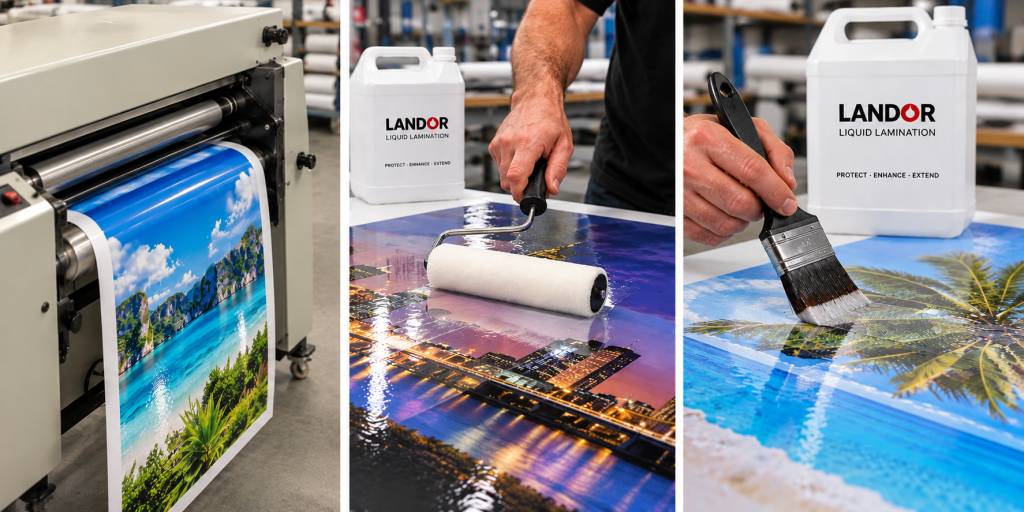
A freshly printed graphic can look exceptional when it leaves the printer, then quickly lose its impact once it meets a trolley, a cleaning regime, sunlight, rain or thousands of passing hands. Liquid lamination gives print businesses and end users a practical way to enhance, protect and preserve digitally printed surfaces without relying on conventional plastic laminate films. Films can delaminate over time, whereas liquid lamination forms a natural bond with the surfaces and materials it is applied to.
For vehicle graphics, exterior signage, wallcoverings, displays and fine-art prints, protection is not simply a finishing choice. It affects the useful life of the graphic, the cost of replacement, the confidence of the installer and the reputation of the print supplier or the brand using it. The right coating system can retain colour, improve surface durability and make a printed asset fit for the environment it must serve.
Liquid lamination is a clear protective varnish coating applied over a printed image or graphic. Once cured or dried, it forms a protective surface that improves resistance to abrasion and moisture, protects against premature fading from UV exposure, and resists dirt, pollutants and routine handling. Depending on the product selected, it can also deliver chemical resistance, anti-graffiti performance or anti-microbial protection.
Unlike a pressure-sensitive finishing film, a liquid coating follows the printed surface rather than adding another pre-manufactured layer of plastic. This matters where films can lift at the edges, struggle over textured materials, show stress around contours or prove impractical on very large, irregular or flexible applications.
The coating can also alter the visual character of the print. Gloss finishes can strengthen perceived colour depth and contrast. Matt finishes help reduce glare on displays and wall graphics. Specialist finishes can provide a more tactile surface, support cleanability or protect a print without noticeably changing its intended appearance.
Protection must be matched to the job. A short-term indoor poster does not face the same risks as a fleet lorry curtain, a hospital wall graphic or a retail display panel cleaned several times a day. Applying more coating than necessary adds avoidable cost, while under-specifying protection may lead to premature failure.
Most graphics do not fail because the image was printed badly. They fail where the printed surface meets real use. A vehicle wrap is exposed to road film, wash chemicals, rain, UV radiation and repeated contact. A public-space graphic may be scuffed by bags, shoes, furniture and cleaning equipment. Wallpaper can be marked by hands, wiped repeatedly or affected by moisture in high-use interiors.
Conventional film lamination remains suitable for many jobs, particularly flat sheets and applications where its specific look or performance is appropriate. However, it is not always the most efficient or durable answer. Films introduce adhesive, release liners, trimming time and edge-management considerations. On complex shapes, rough and textured surfaces, flexible substrates or installations where visible overlaps and edges are undesirable, these limitations become more significant.
Liquid systems provide a valuable alternative where edge lifting, delamination, conformability or plastic waste create operational problems. They are especially useful for large-format print producers seeking a coating method that works with their existing production flow, rather than forcing every print into a film-based finishing process.
The first question is not “Which coating is best?” but “What will this print experience after installation?” A coating choice should begin with the substrate, ink set, expected finish, exposure conditions and required service life.
Water-based liquid coatings are a strong option for many digitally printed graphics, wallcoverings, canvas and display applications. They can be applied by roller, brush or suitable spray equipment, making them accessible to both volume producers and smaller studios. Water-based systems offer a lower-odour, sustainability-conscious route to protection and can produce attractive gloss, satin or matt finishes.
UV-curable coatings are often selected where high throughput, immediate curing and demanding surface performance are required. They suit industrial display work, specialist graphics production and applications where rapid handling is commercially important. The equipment, process control and initial investment can be greater, so this route tends to make most sense when production volume and performance requirements justify it.
For inkjet work, compatibility is critical. The coating must work with the ink technology, the media and the intended application. Solvent, eco-solvent, latex and UV prints can have different curing and surface characteristics. A print that feels dry may not be ready for coating, particularly where residual solvent needs time to dissipate. Coating too early can compromise adhesion, appearance or long-term durability.
A test panel remains one of the most useful pieces of production discipline. It allows the printer to check coating flow, coverage, gloss level, drying behaviour, adhesion and final appearance on the actual media. It also gives the installer or brand owner a realistic sample before full production begins.
Gloss, satin and matt are not simply aesthetic preferences. A gloss surface can enhance rich photographic imagery, vehicle liveries and high-impact retail graphics. A matt finish may be preferable where reflections would interfere with viewing, such as museum displays, illuminated interiors or wall graphics under strong lighting.
The substrate changes the result too. A coating on smooth self-adhesive vinyl will look and behave differently from the same coating on textured wallpaper, canvas or a porous display board. The correct application method and coat weight help avoid streaking, pinholing, excessive texture or an uneven sheen.
Vehicle graphics need a coating system that accommodates movement and exposure. Curves, rivets, recesses, flexible banner materials and lorry curtains all place stress on a finished surface. The aim is to preserve colour and print detail while improving resistance to weathering, road grime, wash-down routines and handling during transport.
For wallcoverings, the challenge is often cleanability without sacrificing the visual quality or breathability the chosen material requires. In hospitality, education, healthcare and retail, walls are working surfaces. They are touched, knocked, cleaned and sometimes subjected to staining or graffiti. A suitable protective coating can make a digitally printed wall installation easier to maintain and less likely to need early replacement.
Healthcare and high-touch public settings require an especially careful approach. Anti-microbial coatings may support hygiene-focused specifications, but they should not be presented as a substitute for proper cleaning protocols or infection-control procedures. The coating, cleaning chemistry and substrate must work together, with performance claims supported by the relevant product documentation and test data.
For exhibitions and point-of-sale displays, surface protection often has a simpler commercial purpose: keeping the installation looking new for the full campaign. Scuffs at a show, fingerprints on a launch display or damage during packing and transport can undermine a premium presentation. A clear coating can strengthen the surface while retaining the intended finish.
Fine-art and giclée studios face a different balance. The coating must protect the edition from handling, dust and UV-related fading while respecting tonal subtlety, paper character and the artist’s preferred finish. A light, even application and a properly evaluated test print are essential, particularly on textured fine-art media.
The best coating cannot compensate for poor preparation. Prints should be clean, properly cured and free from silicone, dust, grease and handling marks. The working environment should be controlled as far as possible, because airborne debris can become permanently visible in a clear finish.
Consistency matters. Too little coating can leave weak areas; too much can increase drying time, affect flexibility or create an overly glossy finish. Rollers, spray systems and dedicated coating machinery each have a place. The right choice depends on sheet size, media type, output volume, required finish and available workspace.
For occasional users, a starter kit and a proven application method provide a sensible route into coated production. For busy print rooms, purpose-built machinery can reduce variation, improve throughput and make coat weights more repeatable. This is where practical demonstrations and technical guidance are valuable: a coating process should be configured around the work being produced, not added as an afterthought.
Landor Liquid Lamination supports this application-led approach, helping producers select coating systems for the risks their prints will actually face, rather than applying a generic finish to every job.
Sustainability in print finishing is not just about the coating formulation. It includes material use, waste, replacement frequency, transport and the operational life of the printed asset. Avoiding an additional plastic film and release liner can reduce finishing waste, particularly across high-volume graphics work.
A durable coated print can also reduce the environmental and commercial cost of reprinting. If exterior signage, wallcoverings or vehicle graphics stay presentable for longer, fewer replacement jobs are needed. That benefit depends on honest specification. No coating makes every substrate indestructible, and severe abrasion, unsuitable cleaning chemicals or poor installation can still shorten service life.
The most effective protection is the one selected before production begins. Define the environment, test the print and coating together, then build the finishing method into the job specification. That is how a printed graphic stays worthy of the image it carries, long after the day it is installed.
